1. What is the purpose of the OSI physical layer?
§ controlling access to media
§ transmitting
bits across the local media
§ performing error detection on received frames
§ exchanging frames between nodes over physical network
media
2. Why
are two strands of fiber used for a single fiber optic connection?
§ The two strands allow the data to travel for longer
distances without degrading.
§ They prevent crosstalk from causing interference on
the connection.
§ They increase the speed at which the data can travel.
§ They
allow for full-duplex connectivity.
3.
Which characteristic describes crosstalk?
§ the distortion of the network signal from fluorescent
lighting
§ the
distortion of the transmitted messages from signals carried in adjacent wires
§ the weakening of the network signal over long cable
lengths
§ the loss of wireless signal over excessive distance
from the access point
4.
Which procedure is used to reduce the effect of crosstalk in copper cables?
§ requiring proper grounding connections
§ twisting
opposing circuit wire pairs together
§ wrapping the bundle of wires with metallic shielding
§ designing a cable infrastructure to avoid crosstalk
interference
§ avoiding sharp bends during installation
5.
Match the situation with the appropriate use of network media.
6. A
network administrator is measuring the transfer of bits across the company
backbone for a mission critical financial application. The administrator
notices that the network throughput appears lower than the bandwidth expected.
Which three factors could influence the differences in throughput? (Choose
three.)
§ the
amount of traffic that is currently crossing the network
§ the sophistication of the encapsulation method applied
to the data
§ the
type of traffic that is crossing the network
§ the
latency that is created by the number of network devices that the data is
crossing
§ the bandwidth of the WAN connection to the Internet
§ the reliability of the gigabit Ethernet infrastructure
of the backbone
Explanation: Throughput usually does not match the specified
bandwidth of physical links due to multiple factors. These factors include, the
amount of traffic, type of traffic, and latency created by the network devices
the data has to cross.
7. What are two characteristics of fiber-optic
cable? (Choose two.)
§ It is
not affected by EMI or RFI.
§ Each pair of cables is wrapped in metallic foil.
§ It combines the technique of cancellation, shielding,
and twisting to protect data.
§ It typically contains 4 pairs of fiber-optic wires.
§ It is more
expensive than UTP cabling is.
Explanation: Fiber-optic cabling supports higher bandwidth
than UTP for longer distances. Fiber is immune to EMI and RFI, but costs more,
requires more skill to install, and requires more safety precautions.
8. What is a primary role of the Physical layer
in transmitting data on the network?
§ create
the signals that represent the bits in each frame on to the media
§ provide physical addressing to the devices
§ determine the path packets take through the network
§ control data access to the media
Explanation: The OSI physical layer provides the means to
transport the bits that make up a frame across the network media. This layer
accepts a complete frame from the data link layer and encodes it as a series of
signals that are transmitted to the local media.
9. With
the use of unshielded twisted-pair copper wire in a network, what causes
crosstalk within the cable pairs?
§ the
magnetic field around the adjacent pairs of wire
§ the use of braided wire to shield the adjacent wire
pairs
§ the reflection of the electrical wave back from the
far end of the cable
§ the collision caused by two nodes trying to use the
media simultaneously
Explanation: Crosstalk is a type of noise, or interference
that occurs when signal transmission on one wire interferes with another wire.
When current flows through a wire a magnetic field is produced. The produced
magnetic field will interface the signal carried in the adjacent wire.
10.
Refer to the graphic. What type of cabling is shown?
§ STP
§ UTP
§ coax
§ fiber
Explanation: Network cabling include different types of
cables:
§ UTP cable consists of four pairs of color-coded wires
that have been twisted together and then encased in a flexible plastic sheath.
§ STP cable uses four pairs of wires, each wrapped in a
foil shield, which are then wrapped in an overall metallic braid or foil.
§ Coaxial cable uses a copper conductor and a layer of
flexible plastic insulation surrounds the copper conductor.
§ Fiber cable is a flexible, extremely thin, transparent
strand of glass surrounded by plastic insulation.
11. In
addition to the cable length, what two factors could interfere with the
communication carried over UTP cables? (Choose two.)
§ crosstalk
§ bandwidth
§ size of the network
§ signal modulation technique
§ electromagnetic
interference
Explanation: Copper media is widely used in network
communications. However, copper media is limited by distance and signal
interference. Data is transmitted on copper cables as electrical pulses. The
electrical pulses are susceptible to interference from two sources:
§ Electromagnetic interference (EMI) or radio frequency
interference (RFI) – EMI and RFI signals can distort
and corrupt the data signals being carried by copper media.
§ Crosstalk –
Crosstalk is a disturbance caused by the electric or magnetic fields of a
signal on one wire interfering with the signal in an adjacent wire.
12.
Refer to the graphic. What type of cabling is shown?
§ STP
§ UTP
§ coax
§ fiber
13.
Which two devices commonly affect wireless networks? (Choose two.)
§ Blu-ray players
§ home theaters
§ cordless
phones
§ microwaves
§ incandescent light bulbs
§ external hard drives
Explanation: Radio Frequency Interference (RFI) is the
interference that is caused by radio transmitters and other devices that are
transmitting in the same frequency.
14.
Which two statements describe the services provided by the data link layer?
(Choose two.)
§ It defines the end-to-end delivery addressing scheme.
§ It maintains the path between the source and
destination devices during the data transmission.
§ It
manages the access of frames to the network media.
§ It provides reliable delivery through link
establishment and flow control.
§ It ensures that application data will be transmitted
according to the prioritization.
§ It
packages various Layer 3 PDUs into a frame format that is compatible with the
network interface.
Explanation: The data link layer is divided into two sub layers,
namely Logical Link Control (LLC) and Media Access Control (MAC). LLC forms a
frame from the network layer PDU into a format that conforms to the
requirements of the network interface and media. A network layer PDU might be
for IPv4 or IPv6. The MAC sub layer defines the media access processes
performed by the hardware. It manages the frame access to the network media
according to the physical signaling requirements (copper cable, fiber optic,
wireless, etc.)
15.
What is the function of the CRC value that is found in the FCS field of a
frame?
§ to
verify the integrity of the received frame
§ to verify the physical address in the frame
§ to verify the logical address in the frame
§ to compute the checksum header for the data field in
the frame
Explanation: The CRC value in the FCS field of the received
frame is compared to the computed CRC value of that frame, in order to verify
the integrity of the frame. If the two values do not match, then the frame is
discarded.
16.
What is contained in the trailer of a data-link frame?
§ logical address
§ physical address
§ data
§ error
detection
Explanation: The trailer in a data-link frame contains error
detection information that is pertinent to the frame included in the FCS field.
The header contains control information, such as the addressing, while the area
that is indicated by the word “data” includes the data, transport layer PDU,
and the IP header.
17.
Which statement describes a characteristic of the frame header fields of the
data link layer?
§ They all include the flow control and logical
connection fields.
§ Ethernet frame header fields contain Layer 3 source
and destination addresses.
§ They
vary depending on protocols.
§ They include information on user applications.
Explanation: All data link layer protocols encapsulate the
Layer 3 PDU within the data field of the frame. However, the structure of the
frame and the fields that are contained in the header vary according to the
protocol. Different data link layer protocols may use different fields, like
priority/quality of service, logical connection control, physical link control,
flow control, and congestion control.
18. A
network team is comparing physical WAN topologies for connecting remote sites
to a headquarters building. Which topology provides high availability and connects
some, but not all, remote sites?
§ mesh
§ partial
mesh
§ hub and spoke
§ point-to-point
Explanation: Partial mesh topologies provide high
availability by interconnecting multiple remote sites, but do not require a
connection between all remote sites. A mesh topology requires point-to-point
links with every system being connected to every other system. A point-to-point
topology is where each device is connected to one other device. A hub and spoke
uses a central device in a star topology that connects to other point-to-point
devices.
19.
Which two fields or features does Ethernet examine to determine if a received
frame is passed to the data link layer or discarded by the NIC? (Choose two.)
§ auto-MDIX
§ CEF
§ Frame
Check Sequence
§ minimum
frame size
§ source MAC address
Explanation: An Ethernet frame is not processed and is
discarded if it is smaller than the minimum (64 bytes) or if the calculated
frame check sequence (FCS) value does not match the received FCS value.
Auto-MDIX (automatic medium-dependent interface crossover) is Layer 1
technology that detects cable straight-through or crossover types. The source
MAC address is not used to determine how the frame is received. CEF (Cisco
Express Forwarding) is a technology used to expedite Layer 3 switching.
20.
Which media communication type does not require media arbitration in the data
link layer?
§ deterministic
§ half-duplex
§ full-duplex
§ controlled access
Explanation: Half-duplex communication occurs when both
devices can both transmit and receive on the medium but cannot do so
simultaneously. Full-duplex communication occurs when both devices can transmit
and receive on the medium at the same time and therefore does not require media
arbitration. Half-duplex communication is typically contention-based, whereas
controlled (deterministic) access is applied in technologies where devices take
turns to access the medium.
21.
Which statement describes an extended star topology?
§ End
devices connect to a central intermediate device, which in turn connects to
other central intermediate devices.
§ End devices are connected together by a bus and each
bus connects to a central intermediate device.
§ Each end system is connected to its respective
neighbor via an intermediate device.
§ All end and intermediate devices are connected in a
chain to each other.
Explanation: In an extended star topology, central
intermediate devices interconnect other star topologies.
22.
What is a characteristic of the LLC sublayer?
§ It provides the logical addressing required that
identifies the device.
§ It provides delimitation of data according to the
physical signaling requirements of the medium.
§ It
places information in the frame allowing multiple Layer 3 protocols to use the
same network interface and media.
§ It defines software processes that provide services to
the physical layer.
Explanation: The Logical Link Control (LLC) defines the software
processes that provide services to the network layer protocols. The information
is placed by LLC in the frame and identifies which network layer protocol is
being used for the frame. This information allows multiple Layer 3 protocols,
such as IPv4 and IPv6, to utilize the same network interface and media.
23.
What are three ways that media access control is used in networking? (Choose
three.)
§ Ethernet
utilizes CSMA/CD.
§ Media
access control provides placement of data frames onto the media.
§ Contention-based access is also known as
deterministic.
§ 802.11 utilizes CSMA/CD.
§ Data
link layer protocols define the rules for access to different media.
§ Networks with controlled access have reduced
performance due to data collisions.
Explanation: Wired Ethernet networks use CSMA/CD for media
access control. IEEE 802.11 wireless networks use CSMA/CA, a similar method.
Media access control defines the way data frames get placed on the media. The
controlled access method is deterministic, not a contention-based access to
networks. Because each device has its own time to use the medium, controlled
access networks such as legacy Token Ring do not have collisions.
24.
During the encapsulation process, what occurs at the data link layer for a PC
connected to an Ethernet network?
§ An IP address is added.
§ The logical address is added.
§ The
physical address is added.
§ The process port number is added.
Explanation: The Ethernet frame includes the source and
destination physical address. The trailer includes a CRC value in the Frame
Check Sequence field to allow the receiving device to determine if the frame
has been changed (has errors) during the transmission.
25.
What three items are contained in an Ethernet header and trailer? (Choose
three.)
§ source IP address
§ source MAC
address
§ destination IP address
§ destination
MAC address
§ error-checking
information
Explanation: Layer 2 headers contain the following:
§ Frame start and stop indicator flags at the beginning
and end of a frame
§ Addressing – for Ethernet networks this part of the
header contains source and destination MAC addresses
§ Type field to indicate what Layer 3 protocol is being
used
§ Error detection to determine if the frame arrived
without error
26.
What type of communication rule would best describe CSMA/CD?
§ access
method
§ flow control
§ message encapsulation
§ message encoding
Explanation: Carrier sense multiple access collision
detection (CSMA/CD) is the access method used with Ethernet. The access method
rule of communication dictates how a network device is able to place a signal
on the carrier. CSMA/CD dictates those rules on an Ethernet network and CSMA/CA
dictates those rules on an 802.11 wireless LAN.
27.
Which three basic parts are common to all frame types supported by the data
link layer? (Choose three.)
§ header
§ type field
§ MTU size
§ data
§ trailer
§ CRC value
Explanation: The data link protocol is responsible for
NIC-to-NIC communications within the same network. Although there are many
different data link layer protocols that describe data link layer frames, each frame
type has three basic parts:
§ Header
§ Data
§ Trailer
28.
Which statement is true about the CSMA/CD access method that is used in
Ethernet?
§ When a device hears a carrier signal and transmits, a
collision cannot occur.
§ A jamming signal causes only devices that caused the
collision to execute a backoff algorithm.
§ All
network devices must listen before transmitting.
§ Devices involved in a collision get priority to
transmit after the backoff period.
Explanation: Legacy bus-topology Ethernet LAN uses CSMA/CD as
network media access control protocol. It works by detecting a collision in the
medium and backing off (after transmitting a jam signal) as necessary. When one
host wants to transmit a frame, it listens on the medium to check if the medium
is busy. After it senses that no one else is transmitting, the host starts
transmitting the frame, it also monitors the current level to detect a
collision. If it detects a collision, it transmits a special jam signal so that
all other hosts can know there was a collision. The other host will receive
this jam signal and stop transmitting. After this, both hosts enter an
exponential backoff phase and retry transmission.
29.
What is the auto-MDIX feature on a switch?
§ the automatic configuration of an interface for 10/100/1000
Mb/s operation
§ the
automatic configuration of an interface for a straight-through or a crossover
Ethernet cable connection
§ the automatic configuration of full-duplex operation
over a single Ethernet copper or optical cable
§ the ability to turn a switch interface on or off
accordingly if an active connection is detected
Explanation: The auto-MDIX enables a switch to use a
crossover or a straight-through Ethernet cable to connect to a device
regardless of the device on the other end of the connection.
30.
Refer to the exhibit. What is the destination MAC address of the Ethernet frame
as it leaves the web server if the final destination is PC1?
§ 00-60-2F-3A-07-AA
§ 00-60-2F-3A-07-BB
§ 00-60-2F-3A-07-CC
§ 00-60-2F-3A-07-DD
Explanation: The destination MAC address is used for local
delivery of Ethernet frames. The MAC (Layer 2) address changes at each network
segment along the path. As the frame leaves the web server, it will be
delivered by using the MAC address of the default gateway.
31. A
Layer 2 switch is used to switch incoming frames from a 1000BASE-T port to a
port connected to a 100Base-T network. Which method of memory buffering would
work best for this task?
§ port-based buffering
§ level 1 cache buffering
§ shared
memory buffering
§ fixed configuration buffering
Explanation: With shared memory buffering, the number of
frames stored in the buffer is restricted only by the of the entire memory
buffer and not limited to a single port buffer. This permits larger frames to
be transmitted with fewer dropped frames. This is important to asymmetric
switching, which applies to this scenario, where frames are being exchanged
between ports of different rates. With port-based memory buffering, frames are
stored in queues that are linked to specific incoming and outgoing ports making
it possible for a single frame to delay the transmission of all the frames in
memory because of a busy destination port. Level 1 cache is memory used in a
CPU. Fixed configuration refers to the port arrangement in switch hardware.
32. What are two examples of the cut-through
switching method? (Choose two.)
§ store-and-forward switching
§ fast-forward
switching
§ CRC switching
§ fragment-free
switching
§ QOS switching
Explanation: Store-and forward switching accepts the entire
frame and performs error checking using CRC before forwarding the frame.
Store-and-forward is often required for QOS analysis. Fast-forward and
fragment-free are both variations of the cut-through switching method where
only part of the frame is received before the switch begins to forward it.
33. Which frame forwarding method receives
the entire frame and performs a CRC check to detect errors before forwarding
the frame?
§ cut-through switching
§ store-and-forward
switching
§ fragment-free switching
§ fast-forward switching
Explanation: Fast-forward and fragment-free switching are
variations of cut-through switching, which begins to forward the frame before
the entire frame is received.
34. What
is the purpose of the FCS field in a frame?
§ to obtain the MAC address of the sending node
§ to verify the logical address of the sending node
§ to compute the CRC header for the data field
§ to
determine if errors occurred in the transmission and reception
Explanation: The FCS field in a frame is used to detect any
errors in the transmission and receipt of a frame. This is done by comparing
the CRC value within the frame against a computed CRC value of the frame. If
the two values do not match, then the frame is discarded.
35.
Which switching method has the lowest level of latency?
§ cut-through
§ store-and-forward
§ fragment-free
§ fast-forward
Explanation: Fast-forward switching begins to forward a frame
after reading the destination MAC address, resulting in the lowest latency.
Fragment-free reads the first 64 bytes before forwarding. Store-and-forward has
the highest latency because it reads the entire frame before beginning to
forward it. Both fragment-free and fast-forward are types of cut-through
switching.
36. A
network administrator is connecting two modern switches using a
straight-through cable. The switches are new and have never been configured.
Which three statements are correct about the final result of the connection?
(Choose three.)
§ The
link between the switches will work at the fastest speed that is supported by
both switches.
§ The
link between switches will work as full-duplex.
§ If both switches support different speeds, they will
each work at their own fastest speed.
§ The
auto-MDIX feature will configure the interfaces eliminating the need for a
crossover cable.
§ The connection will not be possible unless the
administrator changes the cable to a crossover cable.
§ The duplex capability has to be manually configured
because it cannot be negotiated.
Explanation: Modern switches can negotiate to work in
full-duplex mode if both switches are capable. They will negotiate to work
using the fastest possible speed and the auto-MDIX feature is enabled by
default, so a cable change is not needed.
37.
Which advantage does the store-and-forward switching method have compared with
the cut-through switching method?
§ collision detecting
§ frame
error checking
§ faster frame forwarding
§ frame forwarding using IPv4 Layer 3 and 4 information
Explanation: A switch using the store-and-forward switching
method performs an error check on an incoming frame by comparing the FCS value
against its own FCS calculations after the entire frame is received. In
comparison, a switch using the cut-through switching method makes quick
forwarding decisions and starts the forwarding process without waiting for the
entire frame to be received. Thus a switch using cut-through switching may send
invalid frames to the network. The performance of store-and-forward switching
is slower compared to cut-through switching performance. Collision detection is
monitored by the sending device. Store-and-forward switching does not use IPv4
Layer 3 and 4 information for its forwarding decisions.
38.
When the store-and-forward method of switching is in use, what part of the
Ethernet frame is used to perform an error check?
§ CRC in
the trailer
§ source MAC address in the header
§ destination MAC address in the header
§ protocol type in the header
Explanation: The cyclic redundancy check (CRC) part of the
trailer is used to determine if the frame has been modified during transit. If
the integrity of the frame is verified, the frame is forwarded. If the
integrity of the frame cannot be verified, then the frame is dropped.
39. Which switching method uses the CRC value
in a frame?
§ cut-through
§ fast-forward
§ fragment-free
§ store-and-forward
Explanation: When the store-and-forward switching method is
used, the switch receives the complete frame before forwarding it on to the
destination. The cyclic redundancy check (CRC) part of the trailer is used to
determine if the frame has been modified during transit. In contrast, a
cut-through switch forwards the frame once the destination Layer 2 address is
read. Two types of cut-through switching methods are fast-forward and
fragment-free.
40.
What are two actions performed by a Cisco switch? (Choose two.)
§ building a routing table that is based on the first IP
address in the frame header
§ using
the source MAC addresses of frames to build and maintain a MAC address table
§ forwarding frames with unknown destination IP
addresses to the default gateway
§ utilizing
the MAC address table to forward frames via the destination MAC address
§ examining the destination MAC address to add new
entries to the MAC address table
Explanation: Important actions that a switch performs are as
follows:
§ When a frame comes in, the switch examines the Layer 2
source address to build and maintain the Layer 2 MAC address table.
§ It examines the Layer 2 destination address to
determine how to forward the frame. When the destination address is in the MAC
address table, then the frame is sent out a particular port. When the address
is unknown, the frame is sent to all ports that have devices connected to that
network.
41.
Which two statements describe features or functions of the logical link control
sublayer in Ethernet standards? (Choose two.)
§ Logical
link control is implemented in software.
§ Logical link control is specified in the IEEE 802.3
standard.
§ The LLC sublayer adds a header and a trailer to the
data.
§ The
data link layer uses LLC to communicate with the upper layers of the protocol
suite.
§ The LLC sublayer is responsible for the placement and
retrieval of frames on and off the media.
Explanation: Logical link control is implemented in software
and enables the data link layer to communicate with the upper layers of the
protocol suite. Logical link control is specified in the IEEE 802.2 standard.
IEEE 802.3 is a suite of standards that define the different Ethernet types.
The MAC (Media Access Control) sublayer is responsible for the placement and
retrieval of frames on and off the media. The MAC sublayer is also responsible
for adding a header and a trailer to the network layer protocol data unit
(PDU).
42.
What is the auto-MDIX feature?
§ It
enables a device to automatically configure an interface to use a
straight-through or a crossover cable.
§ It enables a device to automatically configure the
duplex settings of a segment.
§ It enables a device to automatically configure the
speed of its interface.
§ It enables a switch to dynamically select the
forwarding method.
Explanation: The auto-MDIX feature allows the device to
configure its network port according to the cable type that is used
(straight-through or crossover) and the type of device that is connected to
that port. When a port of a switch is configured with auto-MDIX, this switch
can be connected to another switch by the use of either a straight-through
cable or a crossover cable.
43. What is one advantage of using the cut-through
switching method instead of the store-and-forward switching method?
§ has a positive impact on bandwidth by dropping most of
the invalid frames
§ makes a fast forwarding decision based on the source
MAC address of the frame
§ has a
lower latency appropriate for high-performance computing applications
§ provides the flexibility to support any mix of
Ethernet speeds
Explanation: Cut-through switching provides lower latency
switching for high-performance computing (HPC) applications. Cut-through
switching allows more invalid frames to cross the network than
store-and-forward switching. The cut-through switching method can make a
forwarding decision as soon as it looks up the destination MAC address of the
frame.
44.
Which is a multicast MAC address?
§ FF-FF-FF-FF-FF-FF
§ 5C-26-0A-4B-19-3E
§ 01-00-5E-00-00-03
§ 00-26-0F-4B-00-3E
Explanation: Multicast MAC addresses begin with the special
value of 01-00-5E.
45.
Refer to the exhibit. What is wrong with the displayed termination?
§ The woven copper braid should not have been removed.
§ The wrong type of connector is being used.
§ The
untwisted length of each wire is too long.
§ The wires are too thick for the connector that is
used.
Explanation: When a cable to an RJ-45 connector is
terminated, it is important to ensure that the untwisted wires are not too long
and that the flexible plastic sheath surrounding the wires is crimped down and
not the bare wires. None of the colored wires should be visible from the bottom
of the jack.
46.
Refer to the exhibit. The PC is connected to the console port of the switch.
All the other connections are made through FastEthernet links. Which types of
UTP cables can be used to connect the devices?
1 - rollover, 2 - crossover, 3 - straight-through
1 -
rollover, 2 - straight-through, 3 - crossover
1 - crossover, 2 - rollover, 3 - straight-through
1 - crossover, 2 - straight-through, 3 - rollover
Explanation: A straight-through cable is commonly used to
interconnect a host to a switch and a switch to a router. A crossover cable is
used to interconnect similar devices together like switch to a switch, a host
to a host, or a router to a router. If a switch has the MDIX capability, a
crossover could be used to connect the switch to the router; however, that
option is not available. A rollover cable is used to connect to a router or
switch console port.
47.
Open the PT Activity. Perform the tasks in the activity instructions and then
answer the question.
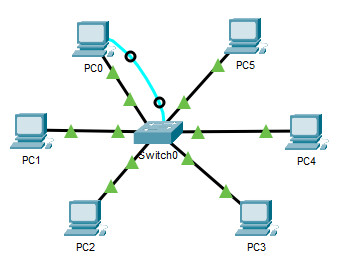
[sociallocker id=”54558″]
Modules 4 -
7: Ethernet Concepts Exam - Packet Tracer 0.00 KB 5356 downloads
...
[/sociallocker]
Which port does Switch0 use to send frames to
the host with the IPv4 address 10.1.1.5?
§ Fa0/1
§ Fa0/5
§ Fa0/9
§ Fa0/11
Explanation: Issuing the command ipconfig /all from
the PC0 command prompt displays the IPv4 address and MAC address. When the IPv4
address 10.1.1.5 is pinged from PC0, the switch stores the source MAC address
(from PC0) along with the port to which PC0 is connected. When the destination
reply is received, the switch takes the destination MAC address and compares to
MAC addresses stored in the MAC address table. Issuing the show mac-address-table on the PC0 Terminal application displays two
dynamic MAC address entries. The MAC address and port entry that does not
belong to PC0 must be the MAC address and port of the destination with the IPv4
address 10.1.1.5.
48.
What does the term “attenuation” mean in data communication?
§ loss of
signal strength as distance increases
§ time for a signal to reach its destination
§ leakage of signals from one cable pair to another
§ strengthening of a signal by a networking device
Explanation: Data is transmitted on copper cables as
electrical pulses. A detector in the network interface of a destination device
must receive a signal that can be successfully decoded to match the signal
sent. However, the farther the signal travels, the more it deteriorates. This
is referred to as signal attenuation.
49.
What makes fiber preferable to copper cabling for interconnecting buildings?
(Choose three.)
§ greater
distances per cable run
§ lower installation cost
§ limited
susceptibility to EMI/RFI
§ durable connections
§ greater
bandwidth potential
§ easily terminated
Explanation: Optical fiber cable transmits data over longer distances
and at higher bandwidths than any other networking media. Unlike copper wires,
fiber-optic cable can transmit signals with less attenuation and is completely
immune to EMI and RFI.
50.
What OSI physical layer term describes the process by which one wave modifies
another wave?
§ modulation
§ IEEE
§ EIA/TIA
§ air
51.
What OSI physical layer term describes the capacity at which a medium can carry
data?
§ bandwidth
§ IEEE
§ EIA/TIA
§ air
53.
What OSI physical layer term describes the measure of the transfer of bits across
a medium over a given period of time?
§ throughput
§ bandwidth
§ latency
§ goodput
54.
What OSI physical layer term describes the amount of time, including delays,
for data to travel from one point to another?
§ latency
§ bandwidth
§ throughput
§ goodput
55.
What OSI physical layer term describes the amount of time, including delays,
for data to travel from one point to another?
§ latency
§ fiber-optic cable
§ air
§ copper cable
56.
What OSI physical layer term describes the measure of usable data transferred
over a given period of time?
§ goodput
§ fiber-optic cable
§ air
§ copper cable
57.
What OSI physical layer term describes the physical medium which uses
electrical pulses?
§ copper
cable
§ fiber-optic cable
§ air
§ goodput
58.
What OSI physical layer term describes the physical medium that uses the
propagation of light?
§ fiber-optic
cable
§ goodput
§ latency
§ throughput
59.
What OSI physical layer term describes the physical medium for microwave
transmissions?
§ air
§ goodput
§ latency
§ throughput
60.
Which two functions are performed at the MAC sublayer of the OSI data link
layer? (Choose two.)
§ Adds Layer 2 control information to network protocol
data.
§ Places information in the frame that identifies which
network layer protocol is being used for the frame.
§ Controls
the NIC responsible for sending and receiving data on the physical medium.
§ Implements
a trailer to detect transmission errors.
§ Enables IPv4 and IPv6 to utilize the same network
interface and media.
Case 2:
§ Provides
synchronization between source and target nodes.
§ Integrates
various physical technologies.
§ Communicates between the networking software at the
upper layers and the device hardware at the lower layers.
§ Adds Layer 2 control information to network protocol
data.
§ Enables IPv4 and IPv6 to utilize the same network
interface and media.
Case 3:
§ Enables IPv4 and IPv6 to utilize the same network
interface and media.
§ Provides
synchronization between source and target nodes.
§ Implements
a trailer to detect transmission errors.
§ Adds Layer 2 control information to network protocol data.
§ Places information in the frame that identifies which
network layer protocol is being used for the frame.
Case 4:
§ Enables IPv4 and IPv6 to utilize the same network
interface and media.
§ Adds Layer 2 control information to network protocol
data.
§ Integrates
various physical technologies.
§ Communicates between the networking software at the
upper layers and the device hardware at the lower layers.
§ Provides
synchronization between source and target nodes.
Case 5:
§ Places information in the frame that identifies which
network layer protocol is being used for the frame.
§ Integrates
various physical technologies.
§ Adds Layer 2 control information to network protocol
data.
§ Controls
the NIC responsible for sending and receiving data on the physical medium.
§ Communicates between the networking software at the
upper layers and the device hardware at the lower layers.
Case 6:
§ Controls
the NIC responsible for sending and receiving data on the physical medium
§ Provides
a mechanism to allow multiple devices to communicate over a shared medium.
61.
Which two functions are performed at the LLC sublayer of the OSI data link
layer? (Choose two.)
§ Enables
IPv4 and IPv6 to utilize the same network interface and media.
§ Places
information in the frame that identifies which network layer protocol is being
used for the frame.
§ Integrates various physical technologies.
§ Implements a process to delimit fields within a Layer
2 frame.
§ Controls the NIC responsible for sending and receiving
data on the physical medium.
64.
Which two functions are performed at the LLC sublayer of the OSI data link
layer? (Choose two.)
§ Adds
Layer 2 control information to network protocol data.
§ Places
information in the frame that identifies which network layer protocol is being
used for the frame.
§ Performs data encapsulation.
§ Controls the NIC responsible for sending and receiving
data on the physical medium.
§ Integrates various physical technologies.
66.
Which two functions are performed at the LLC sublayer of the OSI data link
layer? (Choose two.)
§ Adds
Layer 2 control information to network protocol data.
§ Enables
IPv4 and IPv6 to utilize the same network interface and media.
§ Provides data link layer addressing.
§ Implements a trailer to detect transmission errors.
§ Provides synchronization between source and target
nodes.
68.
Which two functions are performed at the LLC sublayer of the OSI data link
layer? (Choose two.)
§ Enables
IPv4 and IPv6 to utilize the same network interface and media.
§ Adds
Layer 2 control information to network protocol data.
§ Integrates various physical technologies.
§ Implements a trailer to detect transmission errors.
§ Provides synchronization between source and target
nodes.
71.
What action will occur if a switch receives a frame with the destination MAC
address FF:FF:FF:FF:FF:FF?
§ The
switch forwards it out all ports except the ingress port.
§ The switch shares the MAC address table entry with any
connected switches.
§ The switch does not forward the frame.
§ The switch sends the frame to a connected router
because the destination MAC address is not local.
73.
What action will occur if a switch receives a frame with the destination MAC
address 01:00:5E:00:00:D9?
§ The
switch forwards it out all ports except the ingress port.
§ The switch does not forward the frame.
§ The switch sends the frame to a connected router
because the destination MAC address is not local.
§ The switch shares the MAC address table entry with any
connected switches.
74.
What action will occur if a host receives a frame with a destination MAC
address of FF:FF:FF:FF:FF:FF?
§ The
host will process the frame.
§ The host forwards the frame to the router.
§ The host sends the frame to the switch to update the
MAC address table.
§ The host forwards the frame to all other hosts.
75.
What action will occur if a switch receives a frame and does have the source
MAC address in the MAC table?
§ The
switch refreshes the timer on that entry.
§ The switch adds it to its MAC address table associated
with the port number.
§ The switch forwards the frame to the associated port.
§ The switch sends the frame to a connected router
because the destination MAC address is not local.
76.
What action will occur if a host receives a frame with a destination MAC
address of FF:FF:FF:FF:FF:FF?
§ The
host will process the frame.
§ The host returns the frame to the switch.
§ The host replies to the switch with its own IP
address.
§ The host forwards the frame to all other hosts.
78.
What action will occur if a host receives a frame with a destination MAC
address it does not recognize?
§ The
host will discard the frame.
§ The host replies to the switch with its own IP
address.
§ The host forwards the frame to all other hosts.
§ The host returns the frame to the switch.
79.
Which type of UTP cable is used to connect a PC to a switch port?
§ console
§ rollover
§ crossover
§ straight-through
Komentar
Posting Komentar